
February 16, 2026
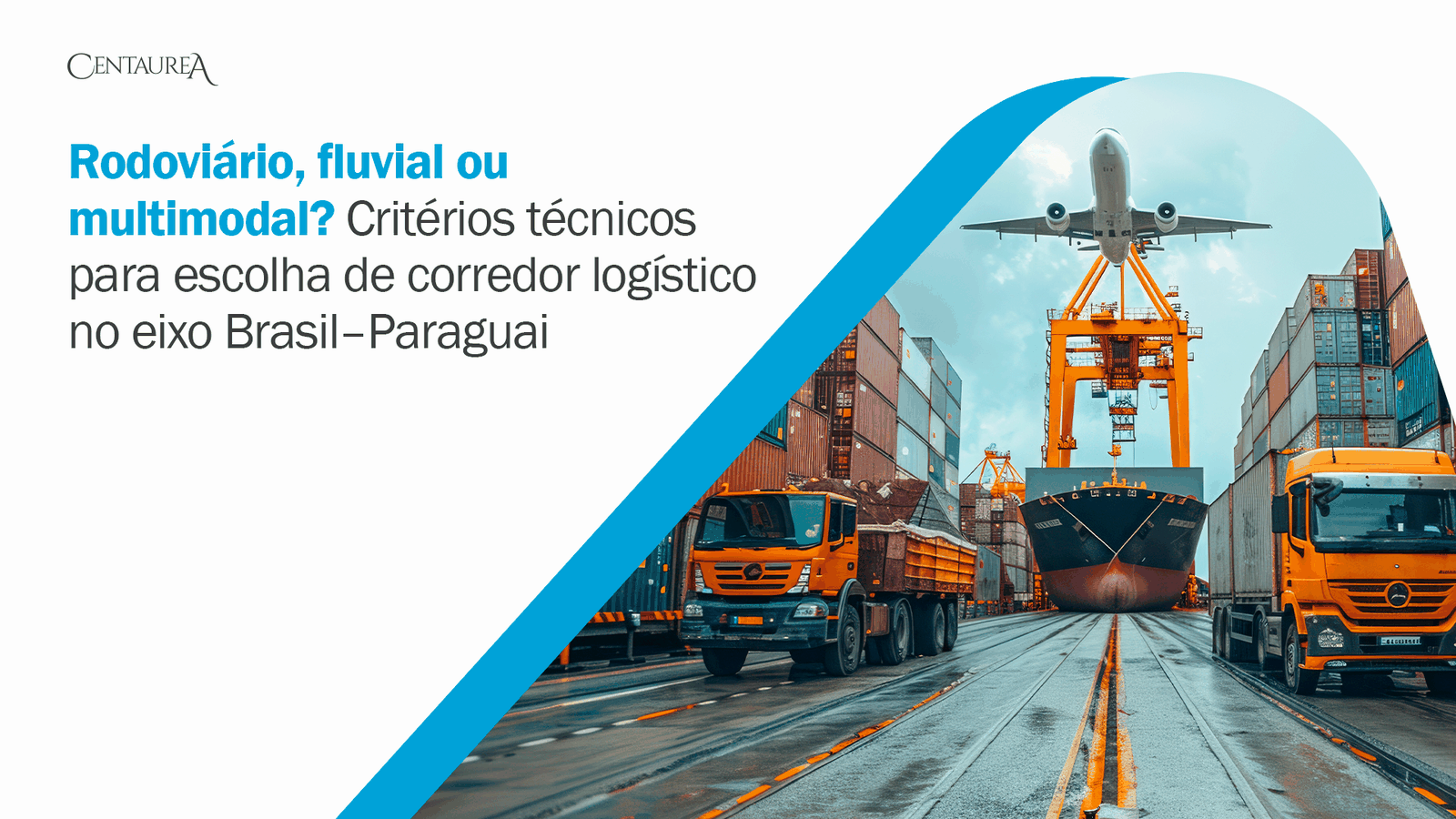
Road, river or multimodal? Technical criteria for choosing a logistics corridor on the Brazil–Paraguay route
The choice of logistics corridor on the Brazil–Paraguay route is still often treated as a predominantly operational decision. However, it is a strategic decision, with direct impacts on total cost, predictability, risk, competitiveness and operational scalability. Road, river and multimodal are not competing alternatives in the abstract. They are different answers for different business structures. The most common mistake is choosing the mode before deeply understanding the logic of the supply chain. A logistics corridor involves far more than the physical route between origin and destination. It integrates cargo profile, operational frequency, tax and customs structure, supplier and customer locations, inventory strategy, and tolerance for risk and variability. When this architecture is not designed in an integrated manner, the corridor shifts from a competitive advantage to a high-risk bottleneck.
When road transport makes sense
Road transport tends to be the natural choice on the Brazil–Paraguay route, especially due to its reach, flexibility and lower initial operational complexity. It is generally technically recommended when:
- The cargo has high added value and requires shorter transit time;
- Demand is less predictable, requiring flexibility;
- Volume does not justify more complex consolidation;
- The operation is still in the structuring phase.
The risk lies in turning road transport into a permanent solution for operations that already require scale, predictability and structural cost reduction.
River transport as a strategy
The Brazil–Paraguay river corridor, especially via the Paraguay–Paraná Waterway, remains underused due to a lack of integrated planning. From a technical standpoint, river transport is advantageous when:
- Volumes are consistent and predictable;
- Logistics costs need to be spread over the long term;
- The cargo is less sensitive to lead time;
- There is operational maturity to deal with hydrological variables.
The most common mistake is assessing river transport solely by transit time, while overlooking its positive impact on cost per tonne, operational stability and supply chain sustainability.
Multimodal: efficiency requires maturity
The multimodal model is not inherently more efficient. It becomes efficient when there is governance, data integration and strategic clarity. On the Brazil–Paraguay route, multimodality is generally recommended when:
- The operation seeks a balance between cost and lead time;
- There is a need to scale volumes without overloading a single mode;
- The company already has maturity in logistics and customs management;
- There is clarity regarding responsibilities, risks and systems integration.
Without this, multimodal operations tend to increase complexity, indirect costs and operational risk.
Technical criteria that should precede the choice of transport mode
Before deciding on the corridor, it is essential to answer strategic questions: What is Paraguay’s role in the supply chain: production, logistics or tax? Is inventory designed to absorb transit variations? Is the company prepared to operate with predictability, or does it need flexibility? Is logistics cost treated as a tactical or structural variable? The answers to these questions define the corridor, not the other way around.
The corridor can support the strategy or consume the margin
On the Brazil–Paraguay route, there is no universally better logistics corridor. There is a corridor that is aligned with the business strategy. Companies that treat this decision as a mere transportation choice tend to face hidden costs, recurring disruptions, operational rework and loss of competitiveness. Those that design their corridors from a strategic perspective, on the other hand, build more resilient, predictable and scalable supply chains. That is why internationalization into Paraguay requires a strategic vision. And that is what Centaurea Professional Logistics offers. Contact us.